
Did you know women can lose up to 10% of their bone density within five years after menopause? This makes bone health a top priority for women over 50. Pilates is a safe, low-impact way to strengthen bones, improve posture, and reduce the risk of falls – all crucial for preventing fractures.
Key Benefits of Pilates for Bone Health:
- Stimulates Bone Growth: Weight-bearing movements like squats and planks help strengthen bones.
- Protects the Spine: Core exercises support spinal alignment and reduce the risk of fractures.
- Improves Balance: Controlled movements enhance stability, lowering fall risk.
- Safe for Osteoporosis: Modified exercises avoid strain on fragile bones.
Quick Tips:
- Start with 2-3 sessions per week for the best results.
- Focus on spine-friendly extensions and balance exercises.
- Avoid forward bending and twisting movements if you have osteoporosis.
Pilates is more than just exercise – it’s a way to build strength, confidence, and resilience for years to come. Let’s explore how it works.
How Pilates Supports Bone Health
Pilates offers a targeted way to support bone health by combining three key benefits: stimulating bone growth through specific movements, building core strength to protect the spine, and improving balance to reduce the risk of falls. These elements are particularly helpful for women over 50. Let’s take a closer look at how each of these works.
How Movement Stimulates Bone Growth
Bones strengthen when they experience controlled stress – a concept known as Wolff’s Law. By engaging in weight-bearing and resistance exercises, bones respond by becoming denser and stronger. Pilates incorporates movements like squats, lunges, and planks, which not only encourage bone growth but also engage muscles to provide resistance and support.
A study published in the Journal for Back and Musculoskeletal Rehabilitation highlights this effect. It found that regular Pilates practice in post-menopausal women can increase bone mineral density, improve overall fitness, and even reduce pain. This means Pilates doesn’t just preserve bone health – it actively contributes to building stronger bones.
Unlike high-impact activities that might feel unsafe or intimidating, Pilates offers a low-impact alternative. Its precise movements target areas most vulnerable to osteoporosis, such as the spine, hips, and wrists.
For those looking to improve posture and flexibility, practising Pilates once a week can make a difference. However, if you’re aiming for stronger bones and better joint support, three reformer Pilates sessions per week are recommended.
Strengthening bones is just one part of the equation. Next, let’s explore how Pilates enhances core strength to protect your spine.
Core Strength and Spinal Health
Think of your core as your body’s natural corset – it stabilises your spine and helps maintain proper alignment. Pilates strengthens the core, which reduces the risk of vertebral fractures by supporting the spine and improving posture. This is especially important as bone density declines with age, leaving the spine more prone to compression fractures.
When your spine retains its natural curves and your pelvis is in a neutral position, the pressure on individual vertebrae decreases. This alignment helps prevent the forward head posture and rounded shoulders that often develop over time.
Whether you’re lifting groceries, gardening, or simply standing at the counter, a strong core ensures your spine stays protected and properly aligned. Pilates also emphasises body alignment and joint mobility, allowing your spine to move efficiently while staying strong enough to handle daily activities without unnecessary strain.
While core strength is essential, improving balance is equally crucial for preventing falls.
Improving Balance to Prevent Falls
For individuals with low bone density, falls are the main cause of fractures. That’s why balance training is so important. Pilates enhances balance and body awareness, which helps reduce fall risk.
Studies show that Pilates might be more effective at improving balance than general physical exercise. This is because Pilates focuses on controlled, deliberate movements that challenge stability while building the strength needed to stay upright.
For example, older adults who practise Pilates on a reformer just once a week often see improvements in balance and mobility within 10 weeks. After three months, participants in Pilates programmes have shown higher physical performance scores.
By strengthening stabilising muscles and improving body awareness, Pilates equips you to navigate uneven surfaces or unexpected obstacles with greater confidence. Specific exercises targeting the trunk, hips, feet, and ankles work together to enhance coordination and stability.
This mindful, controlled approach makes Pilates an excellent choice for women looking to safely build bone strength while reducing the risk of falls.
Safe Pilates Practices for Women With Osteoporosis
Pilates can be an excellent way to build strength and improve balance for those with osteoporosis, but it’s crucial to adapt certain movements to protect your spine. Let’s look at which exercises to approach with caution and how to practise Pilates safely.
Movements to Avoid
When practising Pilates with osteoporosis, it’s essential to avoid movements that place undue stress on fragile bones, particularly the spine. Exercises involving forward flexion (rounding the back), twisting, or extreme ranges of motion should be avoided. Traditional Pilates movements such as the Hundred, Roll Up, Spine Twist, and Spinal Rotation, as well as rolling exercises like Rolling Like a Ball, Roll Down, Hip Roll, The Cat, Curl Up, and Roll Over, may need to be modified or skipped altogether. Similarly, loaded flexion exercises and abdominal moves that lift the head and shoulders can strain the spine. Whenever bending, picking up objects, or getting down to the floor, use the hip hinge technique to keep your spine safe.
"Certainly avoiding loaded thoracic flexion is key, but you can still find ways to mobilize through rotation that is isolated and safe." – Rebekah Rotstein, Pilates instructor, ambassador for American Bone Health, and creator of Buff Bones®
Focus on Spine-Friendly Extensions
Instead of flexion-heavy movements, shift your focus to spine-friendly extensions that maintain a neutral alignment while strengthening the back muscles. The Royal Osteoporosis Society highlights the benefits of Pilates, stating:
"Pilates can help to maintain bone strength and improve muscle strength and balance. It can also help with pain and posture. You can practice Pilates if you have osteoporosis. But there are some exercises where you may ‘over flex’ your spine if you push yourself to the limits. There are some modifications you can make to be on the safe side." – Royal Osteoporosis Society
To protect your back, avoid excessive curvature or strain by using props like wedges, towels, walls, or chairs for support. Perform all movements in a controlled manner, and stop immediately if you feel any pain.
Building Confidence With Balance Exercises
Since falls are a leading cause of fractures in those with low bone density, incorporating balance exercises into your Pilates routine is vital. Pilates offers a range of exercises that gently challenge your balance while helping you build confidence for everyday activities. Standing Pilates movements can improve stability and coordination, making it easier to navigate uneven surfaces or stairs. Exercises on all fours or plank variations are also effective for strengthening key areas like the wrists.
Movements such as the Side Leg Series and Bridge variations are particularly useful for enhancing core strength, alignment, and overall stability. Start with supported balance exercises and gradually progress as your strength improves. Consistency is key, so try to incorporate these exercises into your daily routine.
Working with a qualified instructor who understands osteoporosis modifications can make all the difference in ensuring your Pilates practice is both safe and effective. Up next, we’ll dive into specific Pilates exercises designed to support bone strength.
Best Pilates Exercises for Bone Health
Now that we’ve discussed safe practices, let’s dive into Pilates exercises that actively support bone health. These exercises promote bone strength by enhancing stability and building muscle needed for everyday activities. Below, you’ll find a selection of movements focused on weight-bearing, spinal extension, and balance.
Weight-Bearing and Resistance Movements
Weight-bearing exercises are crucial because they encourage bones to work against gravity and resistance, which helps maintain their strength. For example, the Swan activates the wrists, arms, and back muscles. Footwork on the Pilates reformer targets the legs, hips, and abdominals, while the Scooter strengthens the hips, glutes, and core through lower body engagement. The Standing Side Splits improve both lower body strength and balance. Upper body exercises like the Overhead Arm Press and Arm Jumping focus on the wrists and arms, supporting the shoulder girdle and back extensors to preserve upper body bone density.
Spine Extension and Core Exercises
Strengthening the spine through extension exercises is another way to protect against fractures and maintain posture. The Pulling Straps exercise works the shoulder girdle, spine, shoulder blades, and glutes, promoting an upright posture essential for spinal health. The High Kneeling Chest Expansion targets the muscles of the posterior shoulder and thoracic spine while improving balance. The Down Stretch combines weight-bearing through the arms with strengthening of the abdominals, lower back, and shoulder girdle, ensuring a stable core. For those with limited mobility, the Seated Arm Series offers a great alternative, focusing on the posterior arm, shoulder, and spine without requiring leg engagement.
Balance and Stability Exercises
Balance exercises are key for bone health, especially since falls are a major cause of fractures in individuals with osteoporosis. The Side Kick series strengthens the legs, hips, and spine while improving posture and can be adapted for all fitness levels when performed lying down. Feet in Straps focus on the hamstrings, glutes, and core, enhancing overall stability. Incorporating balance exercises into your routine two to three times per week not only strengthens bones but also boosts coordination and confidence, helping you move through daily life with ease.
Practising these exercises consistently and with proper form is essential for reaping their full benefits for bone health.
sbb-itb-a3ce056
Adding Pilates to Your Bone Health Routine
Incorporating Pilates into your daily life can be a natural way to support your bone strength and overall skeletal health. By making Pilates a consistent part of your routine, you can build a practice that promotes long-term bone health.
Creating a Regular Pilates Schedule
When it comes to improving bone health, consistency is key. Research suggests that practising Pilates 2-3 times a week helps strengthen bones effectively. This frequency provides enough stimulus for your bones while allowing time for recovery between sessions.
Start small – try 10-15 minutes a day – and gradually increase the duration as your strength improves. Many women over 50 find that sticking to the same time each day helps make Pilates a habit. Morning sessions often work well since energy levels are higher, and the day’s distractions haven’t yet taken over.
Proper form is essential to maximise the benefits and avoid injury. As movement expert Karyn Staples highlights:
"Movement and staying active is the number one thing research shows that assists in overall mobility as we age."
In the beginning, focus on quality over quantity. Take it slow and build up both the intensity and duration of your sessions as your confidence grows. Pay attention to your body and adjust exercises as necessary, especially during the early stages of creating your routine. This gradual approach also makes it easier to integrate other bone-strengthening activities into your lifestyle.
Combining Pilates With Other Bone-Healthy Activities
Pilates becomes even more effective for bone health when paired with other activities. Combining Pilates with weight-bearing and resistance exercises can significantly enhance your overall skeletal strength.
For example, you could pair Pilates with walking or light resistance exercises to improve bone density and muscle strength. Adding resistance bands or light weights to your Pilates routine can further target bone health, especially in areas prone to fractures like the hips, spine, and wrists. A 2015 study found that six months of consistent resistance training led to a 1.82% increase in bone mineral density (BMD) in the lumbar spine, compared to minimal change in inactive participants.
Even low-intensity resistance exercises can make a difference. A 2023 study showed that low-load, high-repetition resistance training effectively reduced bone loss, particularly in the lumbar spine and femur. By combining these activities with Pilates, you create a well-rounded approach to bone health. For the best results, seek guidance from trusted experts to ensure you’re practising safely and effectively.
Using Resources From Vikki Davis Fitness
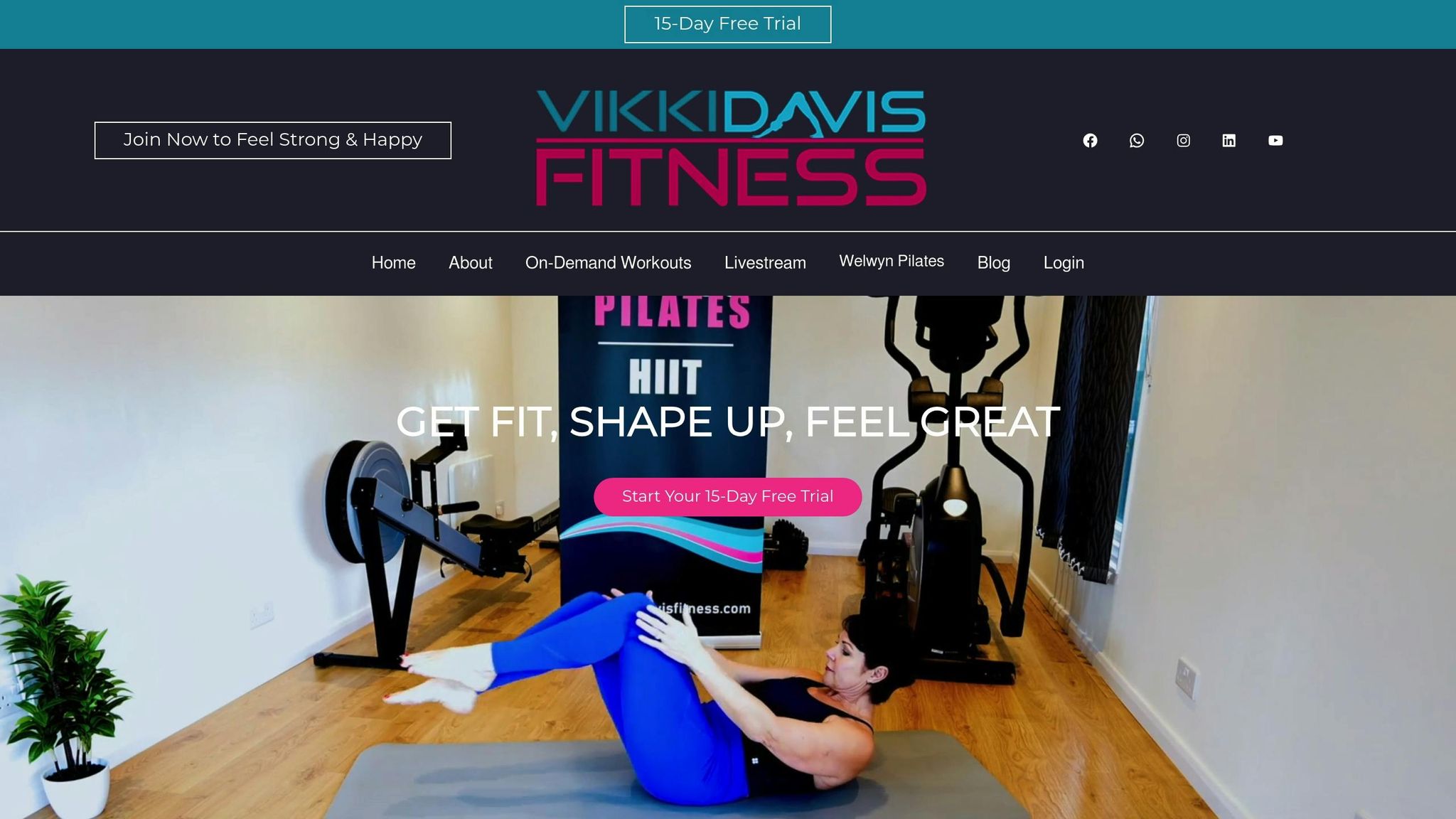
If you’re looking for tailored support, Vikki Davis Fitness offers a range of resources designed for women over 50 who want to prioritise bone health. The platform includes over 250 on-demand workout videos, with programmes that focus on the physical and mental benefits of movement.
For £12.99 per month, the On-Demand Monthly membership gives you unlimited access to Fitness Pilates classes, as well as WalkFit and HIIT/LIIT options. If you’re planning to commit long-term, the yearly membership at £131.88 offers the same benefits at a lower overall cost.
Prefer in-person guidance? Face-to-face Pilates classes in Welwyn provide personalised instruction, which can be particularly helpful for learning proper form and modifications to address bone health concerns. This combination of online flexibility and in-person expertise allows you to customise your fitness journey to suit your needs and comfort level.
The platform’s beginner-friendly programmes and short workout options make it easy to start small and stay consistent. With a variety of classes to choose from, you can find activities that not only support your bone health but also keep you engaged and motivated.
These tools are designed to empower women over 50 to strengthen their bones and improve their overall well-being through movement.
Conclusion: Supporting Women Over 50 Through Pilates
Pilates offers an effective and approachable way for women over 50 to maintain and enhance bone health. By combining weight-bearing exercises, core strengthening, and balance training, it addresses essential factors like bone density, posture, and fall prevention. This well-rounded method fits seamlessly with the personalised guidance offered by Vikki Davis Fitness.
Research highlights the benefits of low-impact, controlled movements in Pilates, showing that regular practice not only helps sustain bone density but also strengthens the entire skeletal system. Its flexible nature makes it suitable for everyone, whether you’re managing conditions like osteoporosis or osteopenia or simply looking to prevent bone loss. With an emphasis on spine-friendly techniques, gradual progression, and controlled movements, Pilates allows you to safely build strength and confidence at your own pace.
Beyond bone health, Pilates supports better posture by strengthening the muscles that promote proper alignment, alleviates chronic lower back pain, and improves balance, reducing the risk of falls . Some studies even suggest that it may enhance cognitive function and boost mental well-being.
Even a short, consistent Pilates routine can make a noticeable difference in your bone health without requiring major lifestyle changes.
At Vikki Davis Fitness, you’ll find expert support every step of the way. With over 250 on-demand videos, in-person classes in Welwyn, and programmes tailored to midlife women, you’ll have everything you need to strengthen your bones and move with confidence.
Pilates isn’t just about preventing future issues – it’s about creating a stronger, more resilient foundation for the years ahead. Make it part of your daily routine to support not only your bone health but your overall well-being.
FAQs
How can Pilates be safely adapted for women with severe osteoporosis?
For women dealing with severe osteoporosis, Pilates can be a safe and effective way to stay active, provided certain adjustments are made. Movements like forward bending, twisting, or rolling exercises, which could increase fracture risk, should be avoided. Instead, the focus should be on gentle, controlled exercises that keep the spine neutral and encourage back extension.
Great options include side-lying leg lifts, seated routines aimed at strengthening the core, and balance-focused exercises. These not only help build muscle strength but also improve stability, which can significantly lower the risk of falls. To ensure safety and effectiveness, it’s crucial to work with a certified instructor who understands osteoporosis and can tailor routines to individual needs.
The aim here is to enhance strength and stability without putting unnecessary pressure on the spine or other fragile areas. Paying attention to proper technique and staying attuned to your body’s limits are key to supporting long-term bone health.
Which Pilates exercises are best for improving balance and preventing falls in women over 50?
Pilates is a fantastic way to improve balance and reduce the likelihood of falls, especially for women over 50. Here are some key exercises to incorporate into your routine:
- Standing Leg Pump: This exercise targets leg and core strength while enhancing overall stability.
- High-Kneeling Chest Expansion: A great move for strengthening the core and encouraging better posture, which plays a big role in balance.
- Plank Variations: These help build core stability, a crucial component in staying steady and avoiding falls.
These exercises not only help build strength but also fine-tune your proprioception – your body’s ability to sense its position in space – making everyday movements feel more secure and confident. Remember to prioritise slow, controlled movements to get the most out of your Pilates practice.
Can Pilates be combined with other exercises to improve bone health, and what activities work best?
Absolutely, Pilates can be blended with other exercises to better support bone health, particularly for women over 50. Adding weight-bearing activities like walking, dancing, or low-impact aerobics to your routine can help stimulate bone growth and increase bone density. These exercises apply gentle stress to your bones, encouraging them to become stronger over time.
Another great option is strength training. Using tools like resistance bands, light weights, or even your own body weight can help build muscle around your bones, offering extra support and reducing the likelihood of fractures. Don’t overlook balance exercises either – practices like standing on one leg or walking heel-to-toe can significantly lower the risk of falls, which is especially important for managing osteoporosis.
By combining Pilates with these activities, you can create a balanced and effective plan that supports both bone health and overall wellbeing.
Leave a Comment and Stay in Touch with Vikki!
You must be logged in to post a comment.